


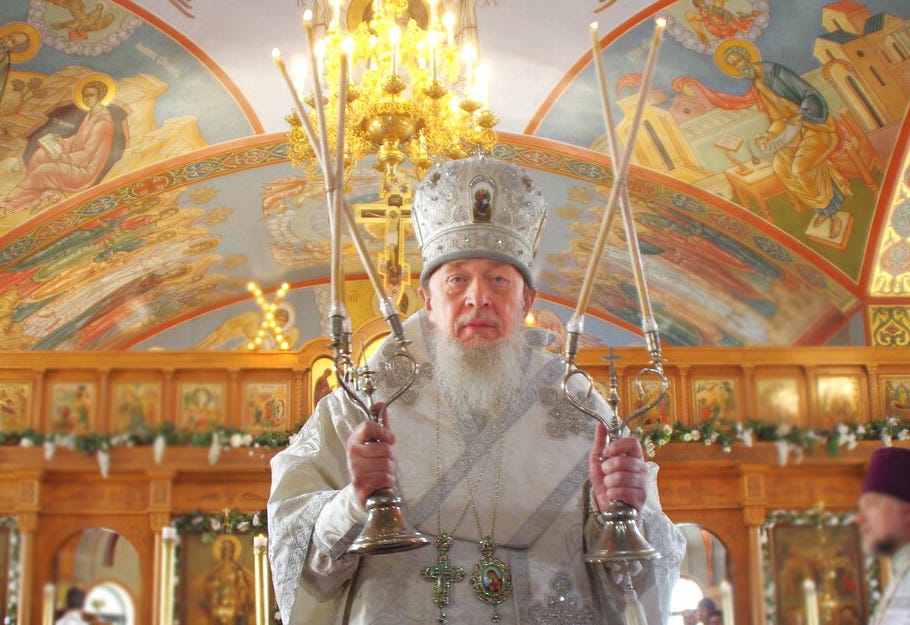
When Bishop Spyridon (Gusakov) was appointed to lead the Russian Orthodox Church Outside of Russia’s (ROCOR) Diocese of Chicago and Mid-America in the spring of 2026, the decision was officially presented as an ordinary episcopal appointment.
For many clergy and parishioners, however, it felt like anything but ordinary.
To them, the appointment marked the abrupt end of a brief but meaningful period of reconciliation under Archbishop Gabriel Chemodakov – a highly respected hierarch who had begun addressing years of internal conflict, restoring trust within the diocese, and allowing an independent financial review to move forward. Instead of bringing stability, Spyridon’s arrival reopened divisions that many believed were finally beginning to heal.
Questions that had once seemed on the verge of receiving answers suddenly became more urgent than ever. Why had the financial investigation been halted? Why had parishioners calling for transparency once again found themselves marginalized? And why had the very man whom Archbishop Gabriel had personally mentored and prepared as a potential successor, accepted leadership of the Chicago Diocese after Gabriel’s tenure as administrator had been ended? Those questions become even more significant in light of another unusual fact.
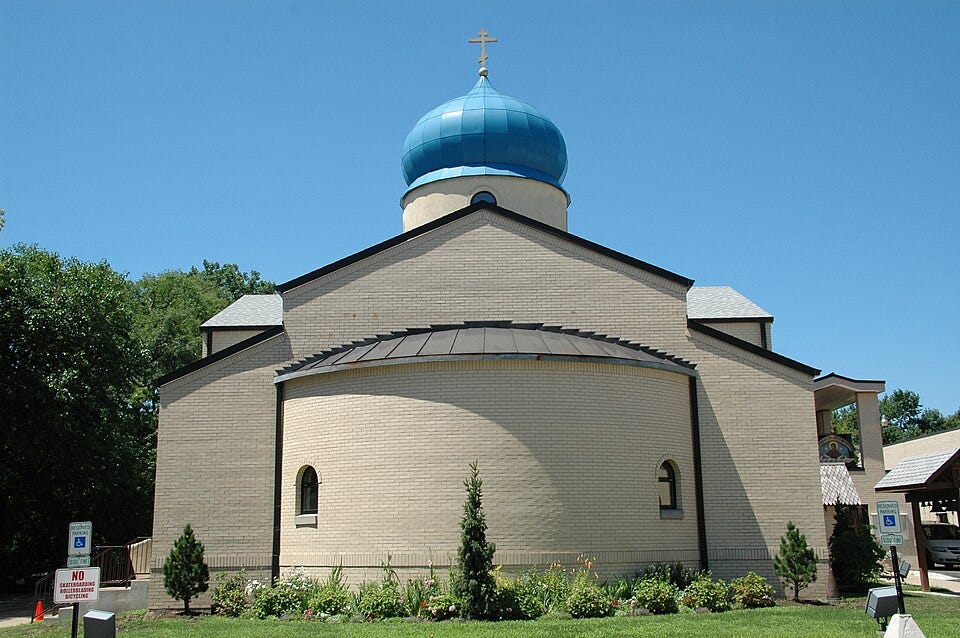
Who is Bishop Spyridon (Gusakov)?
The official biography on ROCOR’s official website states that:
Bishop Spyridon, was born Sergey Valentinovich Gusakov on May 25, 1959, in the city of Kropotkin, Krasnodar Region, USSR, into a military family. He was baptized in July, 1959, with the name Sergiy in the city of Kropotkino.
From 1966 to 1975, he studied at Secondary School No. 25 in the village of Loza, Sergiev Posad District, Moscow Region. From childhood, he attended services at St Sergius/Holy Trinity Lavra. In 1975, he enrolled in Rostov Maritime College, which he graduated from in 1979, and after graduation, he worked until 1988 at the Northern Shipping Company in Arkhangelsk in various command positions.
In 1985, he married Tatyana Alexandrovna Lashchenyk and began living in Zaporizhiye. In 2012, he and his wife divorced. They have two children.
In 1988, he entered Zaporizhiye State University, which he graduated from in 1993, and after graduation, he worked until 2001 in the administration of the Zaporizhiye Ship Repair and Shipbuilding Plant. In September 7, 2001, he immigrated to Canada. His first church in Canada for several years was Holy Trinity Church (Canadian Diocese of the Russian Orthodox Church Outside of Russia) in Vancouver.
Since 2008, he began regularly attending services and serving in the altar of St Nicholas Cathedral in Montreal, Canada. From 2009, he started regularly visiting the Holy Trinity Monastery in Jordanville, NY. In November 2010, he was ordained as a reader and subdeacon.
In 2012, he entered the Holy Trinity Orthodox Seminary in Jordanville, which he graduated from in 2016. On November 20, 2016, he was ordained to the rank of deacon. In December of the same year, he was tonsured a monk. His service as a hierodeacon took place at St Nicholas Cathedral in Montreal. He participated in and assisted Archbishop Gabriel of Montreal and Canada during his visits to all the parishes of the Canadian diocese.
On August 26, 2018, he was ordained to the rank of hieromonk and assigned to serve as the rector of the Church of St John, Archbishop of Shanghai, Wonderworker of San Francisco, in Calgary (Alberta).
Spyridon followed an unconventional path to the episcopate. Consecrated as a bishop in February 2026, he was temporarily made a vicar bishop of the Canadian Diocese. Then, only a few months later, he was promoted by Metropolitan Nicholas to head one of ROCOR’s largest and most influential dioceses in North America. Such a promotion to an important episcopal see, usually takes years of service to attain.
His unusually rapid rise immediately attracted attention inside the Church. He became the first ROCOR bishop to receive most of his theological education through distance learning, a form of preparation that many clergy have long regarded as insufficient for someone expected to assume the responsibilities of the episcopate.
His personal background also set him apart.
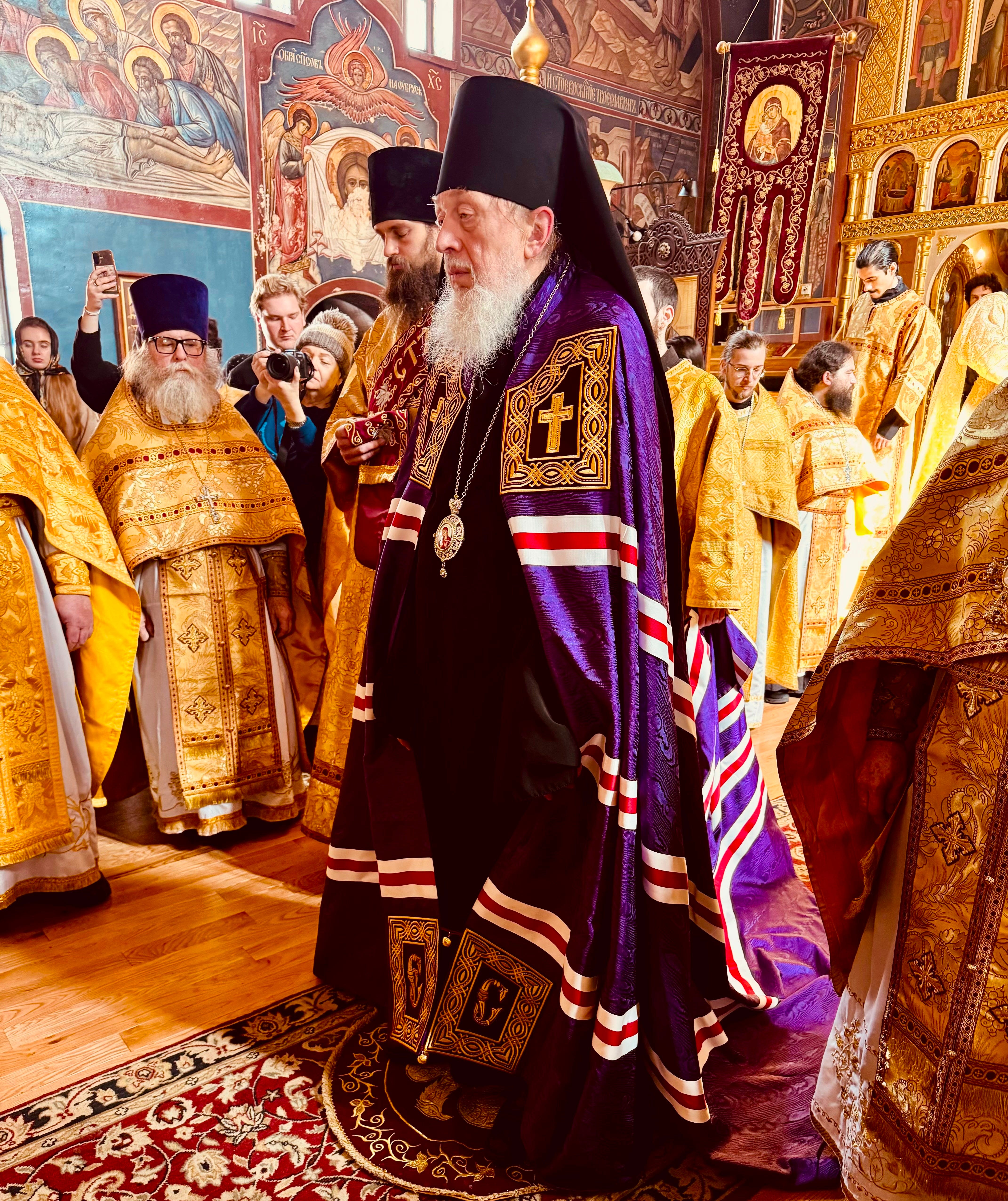
Unlike most ROCOR bishops, whose identities were shaped within the historic Russian émigré community established after the Bolshevik Revolution, Spyridon came from the post-Soviet immigrant community. Within parts of ROCOR, members of that generation have often been viewed as outsiders – sometimes accepted, sometimes quietly tolerated, and occasionally regarded with open skepticism by representatives of the Church’s older émigré establishment. Metropoltan Nicholas himself recently spoke of great ROCOR hierarchs of the past, Archbishops Averky, Nikon and Savva and their heritage of monasticism and theology.
That reality makes Spyridon all the more remarkable. How did someone with such an unconventional background rise so quickly to one of the most influential episcopal sees in ROCOR?
The Wise and Trusted Mentor
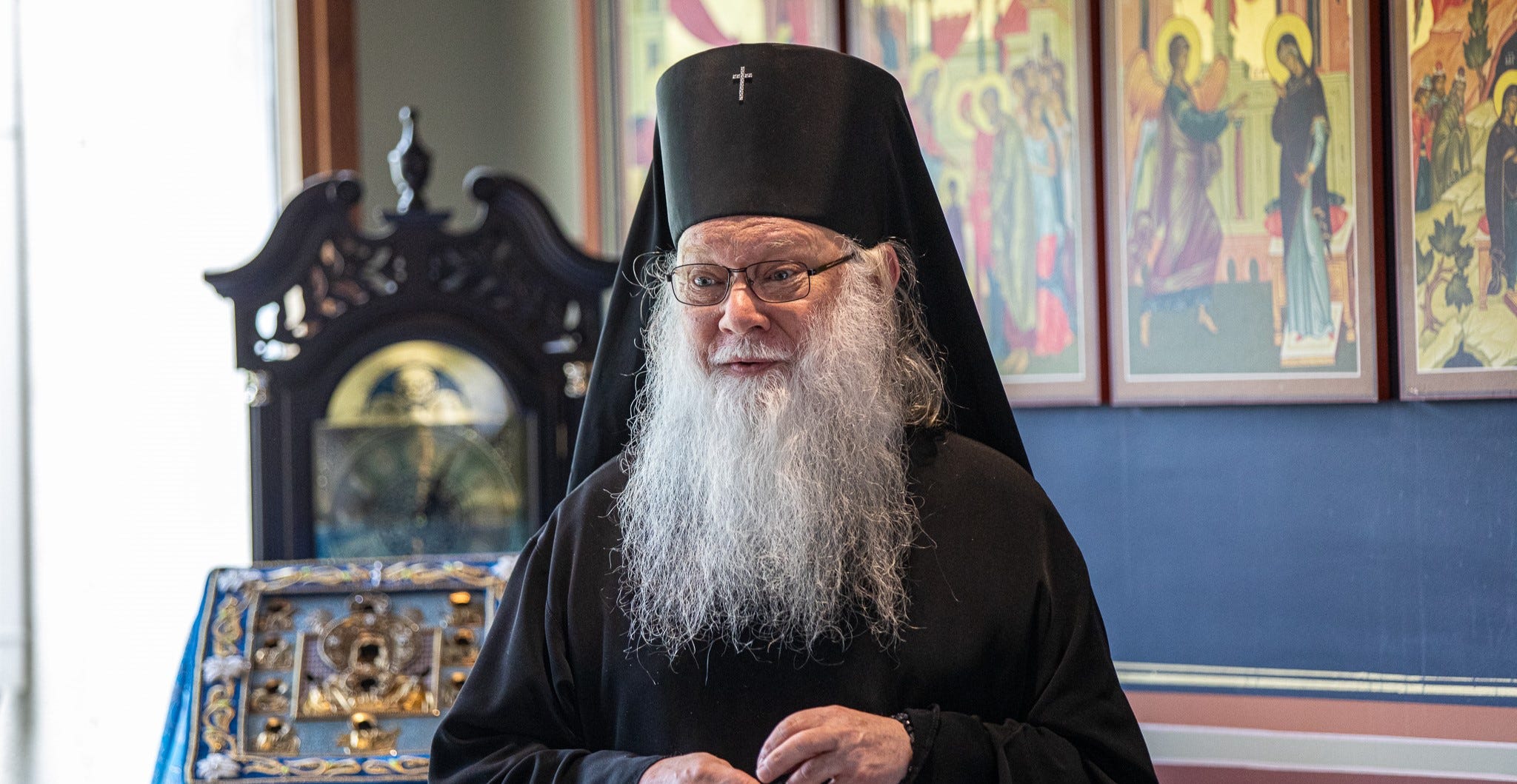
According to numerous people familiar with the Church’s internal life, Archbishop Gabriel Chemodakov of Montreal & Canada was the most important, positive influence on Spyridon. By the account of clergy and laypeople familiar with ROCOR’s internal affairs, he became his mentor, advocate, and principal patron. The Archbishop consistently encouraged Spyridon in his priestly journey and entrusted him with increasing responsibility, believing he possessed the qualities necessary to potentially become a future bishop. More importantly, many within ROCOR believed that Archbishop Gabriel intended Spyridon to succeed him, not in Chicago, but in Canada.
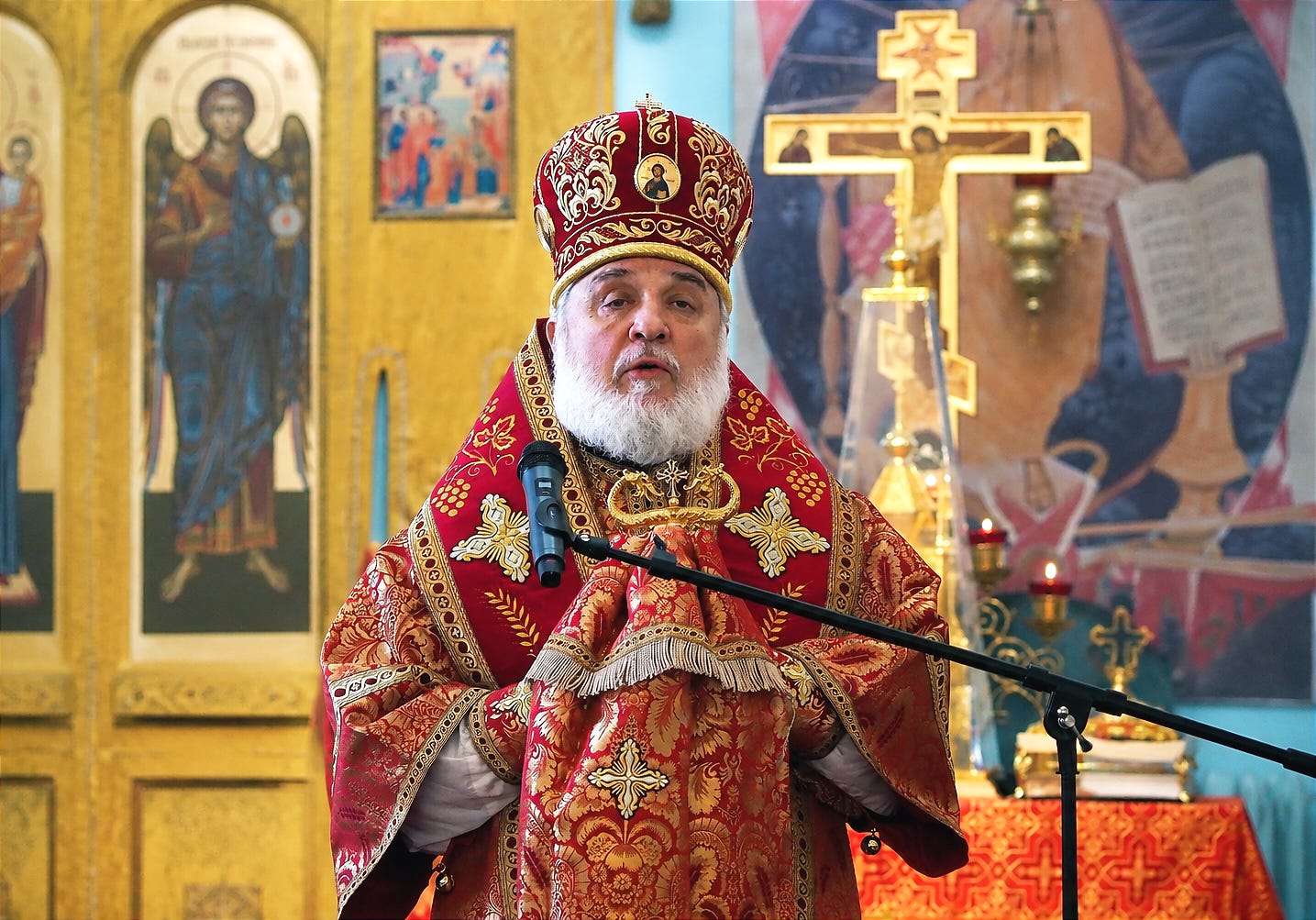
Without Archbishop Gabriel’s confidence and years of generous, patronly support, it is difficult to imagine Spyridon’s rise unfolding with such extraordinary speed. In December 2024, following the repose of Archbishop Peter (Lukianov), Archbishop Gabriel was appointed Temporary Administrator of the Diocese of Chicago and Mid-America. Over the following eighteen months, he earned widespread respect from both clergy and laity. Parishioners admired his humility, accessibility, pastoral sensitivity, and unwavering commitment to fairness. Even those who disagreed with him, often acknowledged his rare ability to defuse conflicts that had divided the community for years. Under his leadership, trust slowly began to return to the diocese. Nowhere was that change more visible than at the Holy Virgin Protection Cathedral in Des Plaines, Illinois – the diocese’s largest parish and the epicenter of many of its longest-running internal disputes.
As a person of Russian heritage, but one that also grew up in the English-speaking world of Australia & the United States, no one was better placed to understand, and reconcile the distinct groups that make up the Russian diaspora today. Holding both American and Russian citizenship, Archbishop Gabriel exhibits love and respect of both his anncestral homeland, as well as the modern Western communities he has lived in all his life.
Parishioners admired Archbishop Gabriel’s humility, accessibility, pastoral sensitivity, and unwavering commitment to fairness. Even those who disagreed with him often acknowledged his rare ability to defuse conflicts that had divided the community for years.
Parishioners holding diverse political outlooks reported that the pressure they had previously experienced largely subsided. Those who had raised questions about parish finances, the operation of the parish school, employment practices, or administrative decision-making likewise found themselves able to speak more openly without the same level of intimidation they said had existed before. Yet many of the underlying problems remained unresolved. By then, fifteen teachers at the parish school had already lost their jobs after asking difficult questions about governance and accountability. Some had devoted nearly three decades of their lives to the school.
Their years of service did not protect them from dismissal, public humiliation, or gradual exclusion from the community they had helped build. As Archbishop Gabriel sought to restore confidence within the diocese, another process was quietly moving forward—one that would ultimately bring him into direct conflict with some of the parish’s most influential figures.
The Financial Investigation That Went Too Far
The financial review that would ultimately reshape the diocese had not begun under Archbishop Gabriel. It had been initiated earlier by Archbishop Peter, who authorized an internal audit of the cathedral’s finances shortly before his sudden death—a death that, for many within the diocese, still raises unanswered questions.
When Archbishop Gabriel assumed temporary leadership of the diocese, he allowed the audit to continue. According to individuals who attended presentations by the audit committee and parish meetings where its findings were discussed, the review uncovered a pattern of financial irregularities serious enough to warrant further investigation. Participants say the committee raised questions that extended well beyond routine bookkeeping and touched on issues that, in their view, could ultimately require review by civil authorities.

Rather than receiving institutional support, however, the audit encountered fierce resistance. Members of the audit committee describe being subjected to intimidation, personal attacks, public defamation, and sustained psychological pressure. According to multiple witnesses, efforts were made not only to undermine the committee’s credibility but also to isolate its members from parish life. Several participants say the pressure eventually extended to their relatives and close associates. For many parishioners, the conflict that followed revealed something larger than a disagreement over accounting practices. It exposed a struggle over who would control the future of the diocese.
By that point, many members of the congregation believed that a small circle of six or seven influential individuals had exercised extraordinary influence over the cathedral’s administrative and financial affairs for years. Archbishop Gabriel represented a very different approach. He called for transparency, accountability, and an independent examination of the audit’s findings before any conclusions were reached. His critics, parishioners contend, had different priorities. According to many members of the congregation, preserving long-established authority – and preventing an independent review from reaching its conclusion—became more important than resolving the questions the audit had raised. It was against that backdrop that ROCOR’s leadership made a decision that fundamentally altered the course of events.
The Appointment That Changed Everything
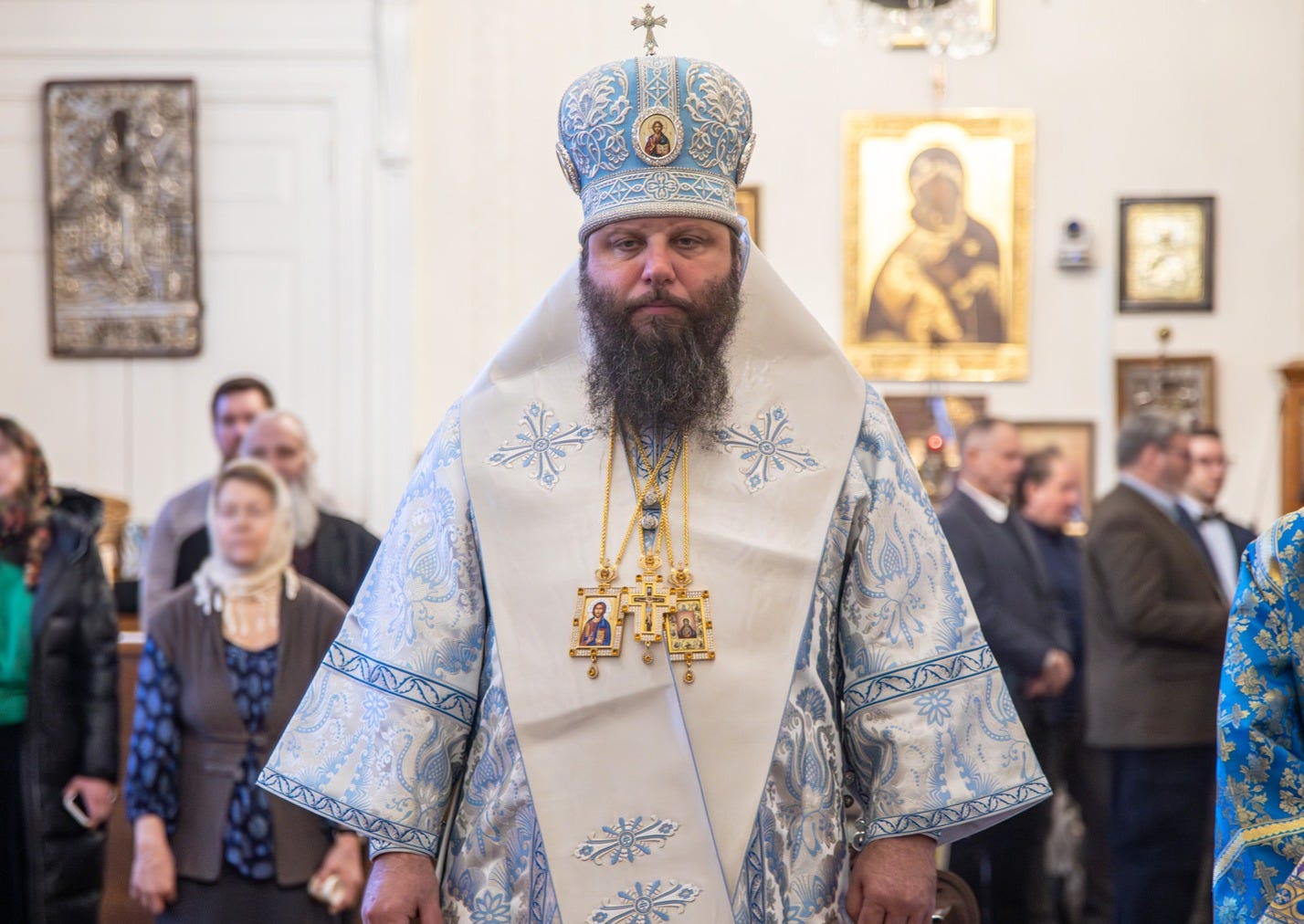
In the spring of 2026, the Synod appointed the newly consecrated and inexperienced Bishop Spyridon as the new ruling bishop of the Diocese of Chicago and Mid-America. This happened after he had served a mere 2 months as a vicar bishop of the Canadian diocese. Such a short period of apprenticeship, before being given the reins of a major diocese like Mid-America is unheard of in recent Orthodox Church history anywhere in recent times.
The decision stunned many throughout the diocese. A significant number of parishioners had previously appealed to ROCOR’s leadership, asking that Archbishop Gabriel remain with them, and be reassigned there permanently as the new Archbishop of Chicago. It is not unusual for bishops to change their see several times during their career. Archbishop Gabriel had enjoyed a long and successful tenure as the Archbishop of Montreal & Canada for 18 years since 2008. Many in Chicago, hoped that this would be an opportune time for such a change and the possibility of his promotion to lead ROCOR’s third largest diocese. The experience and steadfast leadership record of Archbishop Gabriel was exactly what was needed in Chicago in the present time and circumstances.
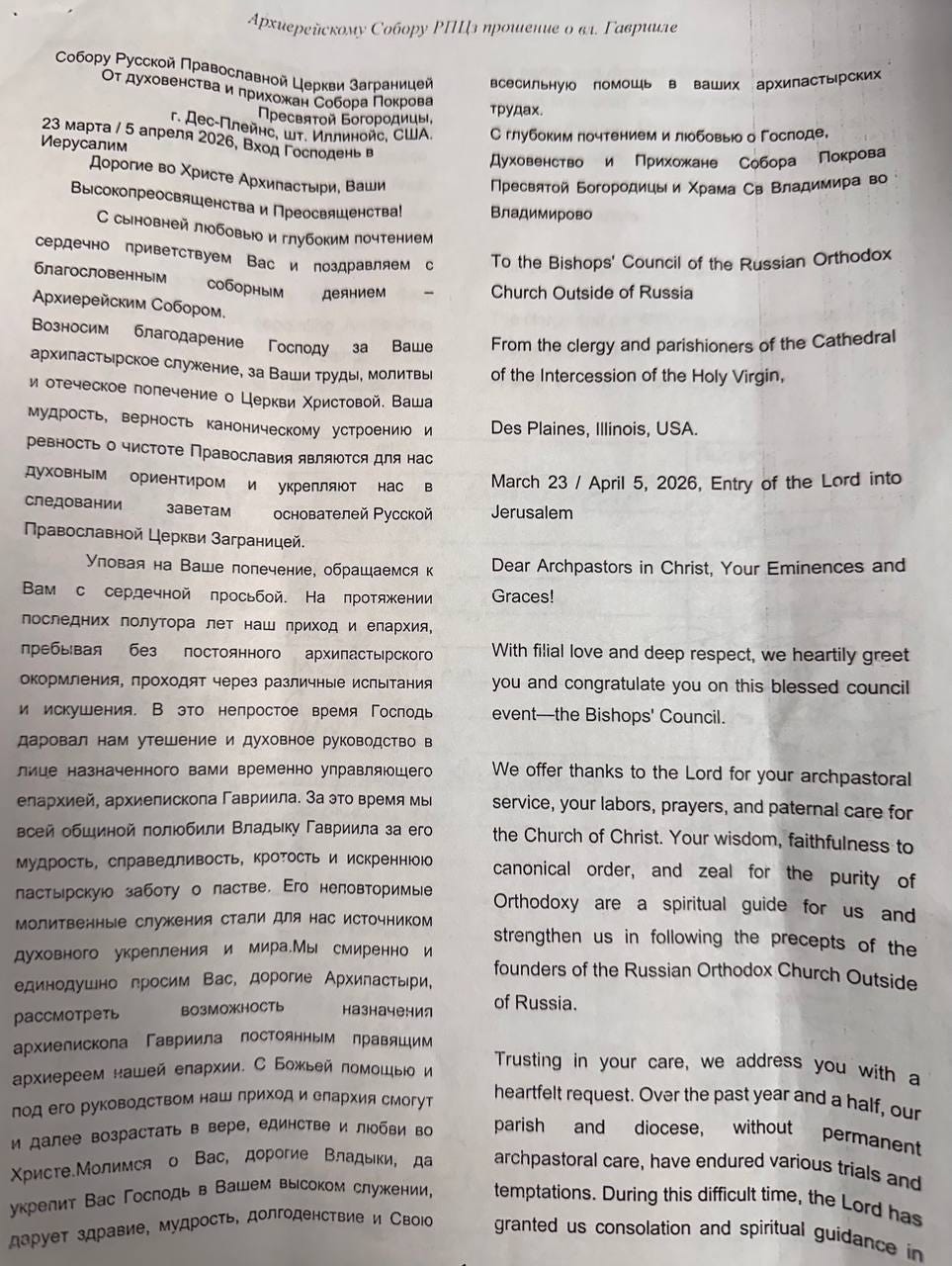
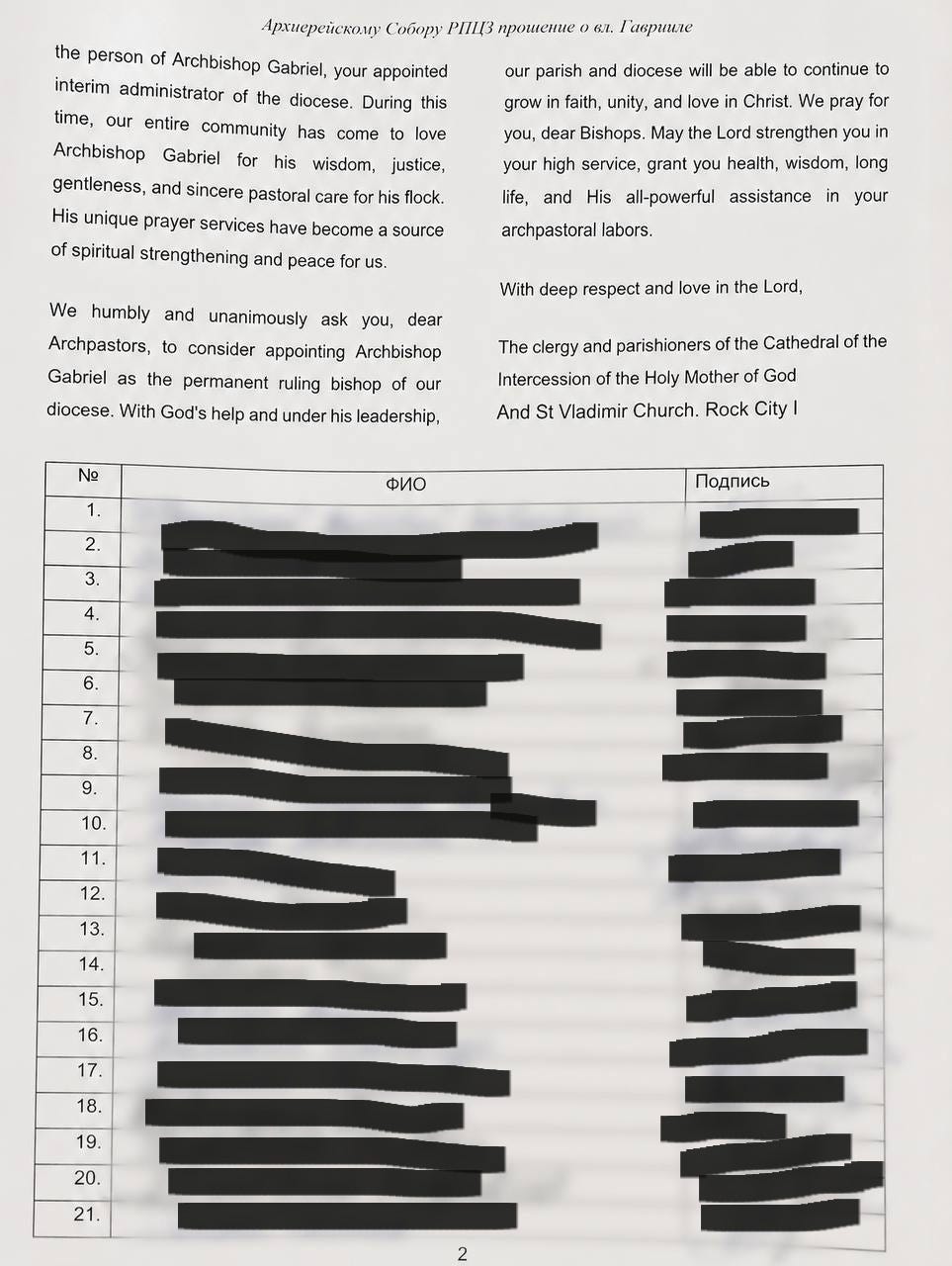
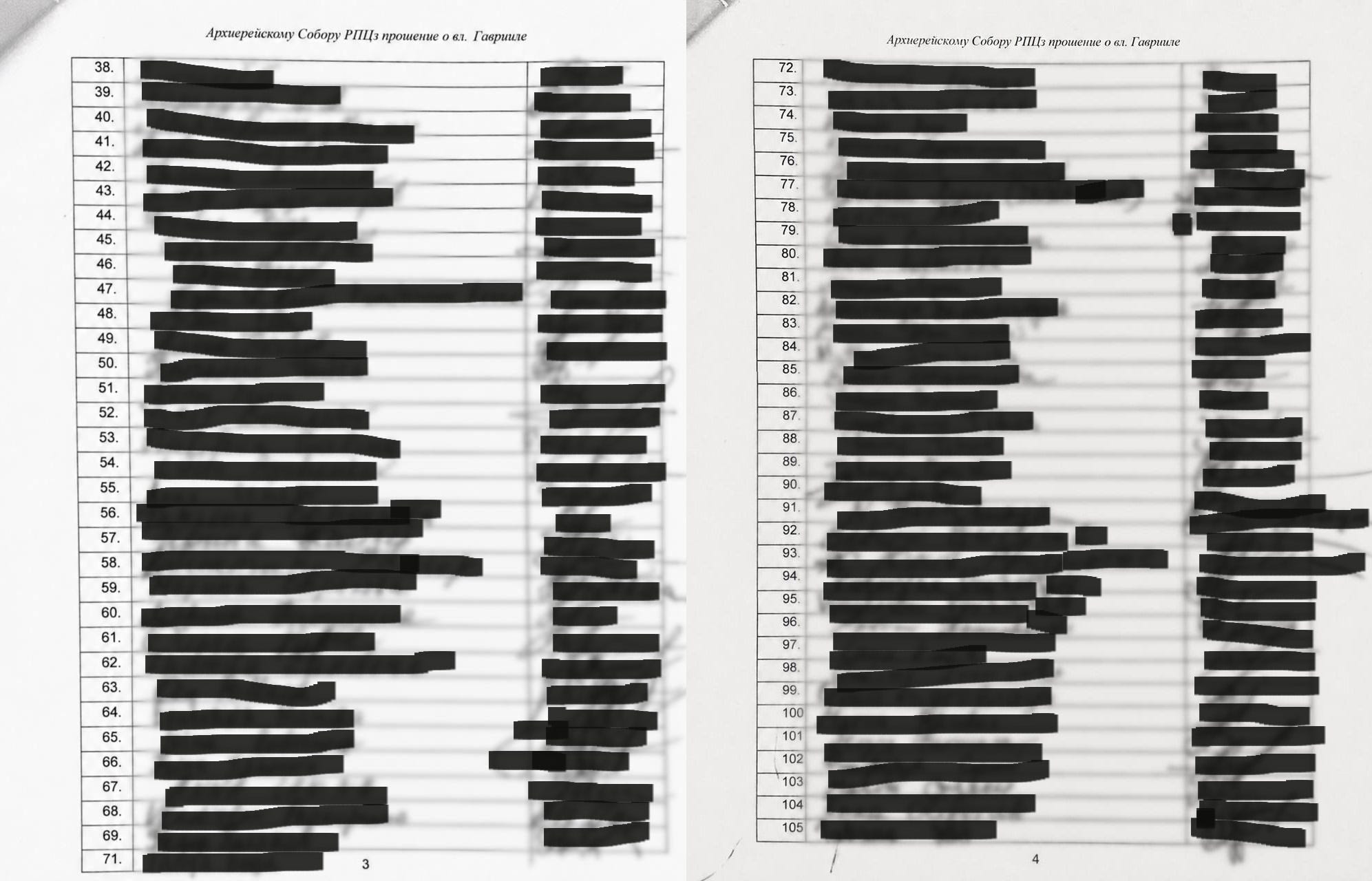
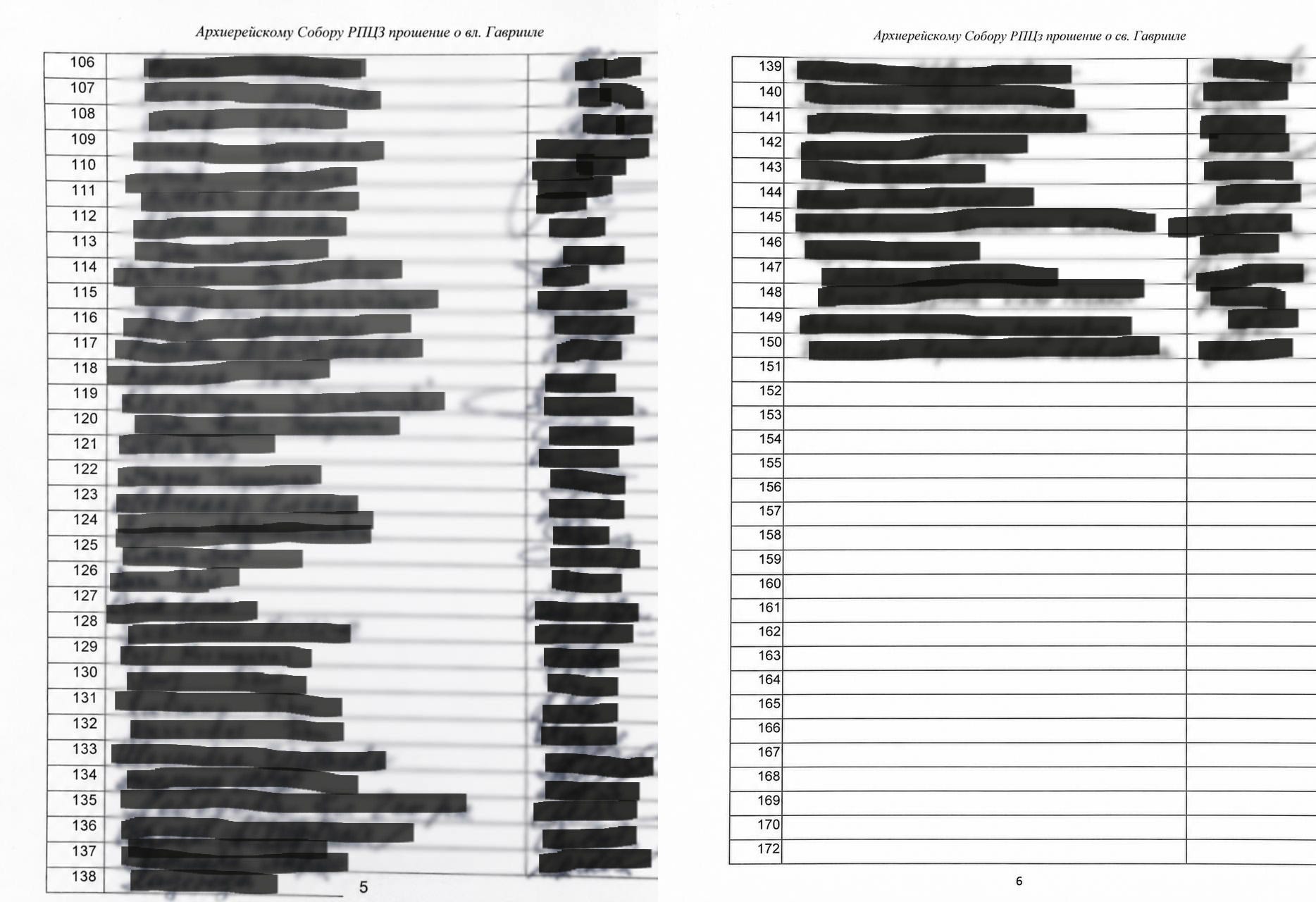
The request of the Chicago faithful however, was denied. To outside observers, the appointment might have appeared to be little more than a routine change in diocesan leadership. Inside the diocese, however, it was widely interpreted as the end of Archbishop Gabriel’s attempt to restore confidence, encourage transparency, and protect those who had spent years calling for accountability. Yet the appointment carried another layer of symbolism that many parishioners found deeply troubling. For years, Archbishop Gabriel had invested personally in Spyridon’s formation as a potential, future bishop. He had mentored and supported him, and, according to numerous people familiar with ROCOR’s internal life, intended him to become his eventual successor in Canada.
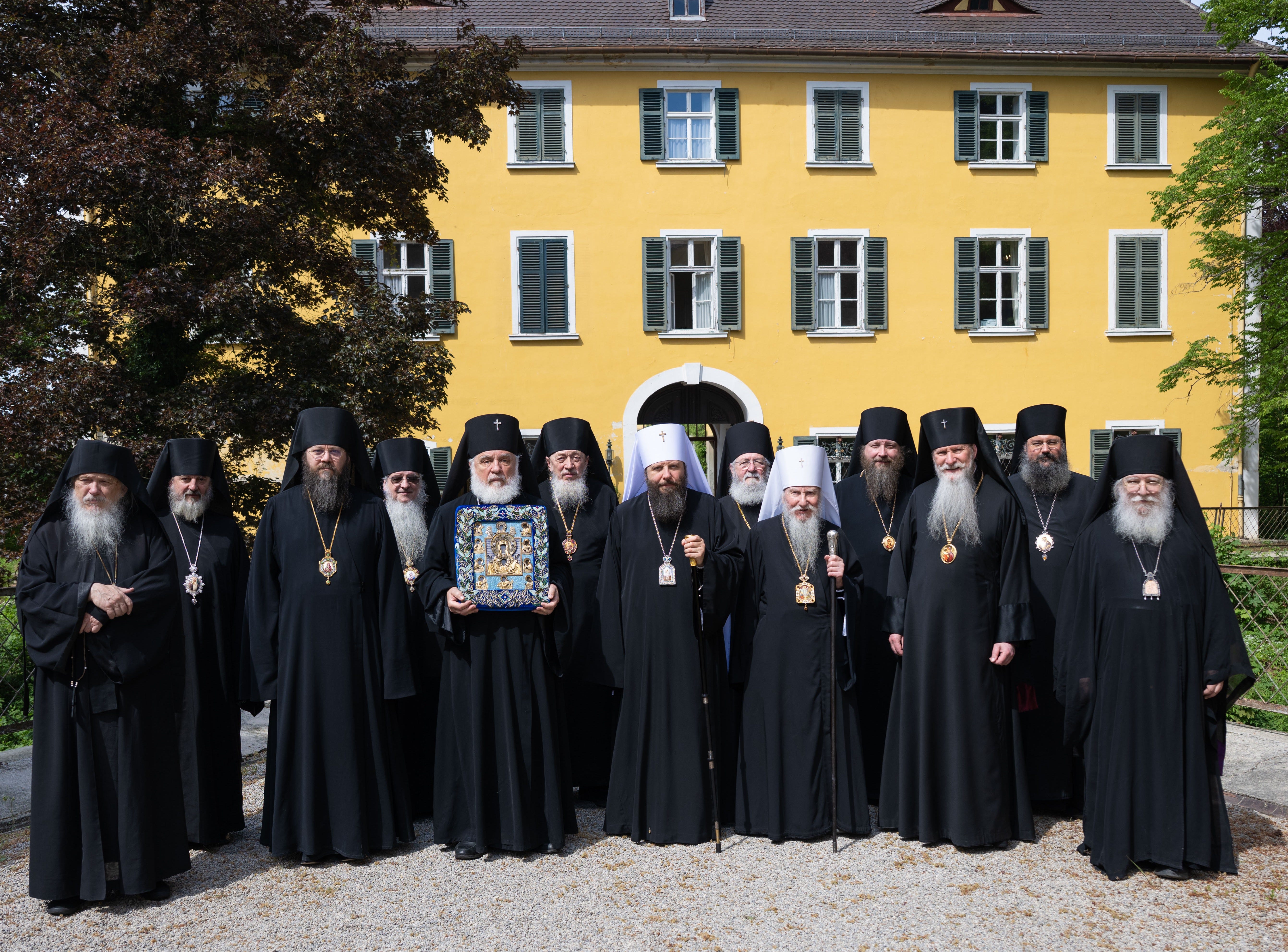
Instead, Spyridon himself accepted leadership of the Chicago Diocese, the very position Archbishop Gabriel had led so capably in the interim, and where he’d had such a tremendously positive impact. Whether intended or not, that decision carried enormous symbolic weight. To many clergy and parishioners, it appeared that a trusted protégé had accepted his mentor’s position, at precisely the moment that mentor had made great strides in addressing the issues of financial transparency and institutional accountability. For many, the impression of a betrayal was hard to ignore. Spyridon even implied that his appointment was: “The will of God” and not just of the ROCOR leadership (see from 0:40 in his video below).
For some, the appointment represented far more than an administrative transition. It felt like the moment when a promising effort to confront long-standing problems inside the diocese came to an abrupt end. Despite the public show of unity at the Bishop’s council, there is no doubt that it was a different story behind closed doors.
Questions of Spyridon’s Citizenship & Legal Status
Spyridon’s appointment also gave rise to questions extending beyond ecclesiastical governance.
He is a Canadian citizen. In addition, his recent acquisition of Russian citizenship was formally confirmed by an official decree signed by Russian President Vladimir Putin, making his Russian citizenship a matter of public record rather than speculation. That fact has drawn attention for another reason. As ruling bishop of one of ROCOR’s largest American dioceses, Spyridon’s responsibilities extend well beyond leading worship services. He oversees clergy, exercises administrative authority, signs official and financial documents, and participates directly in the governance of church institutions operating within the United States.
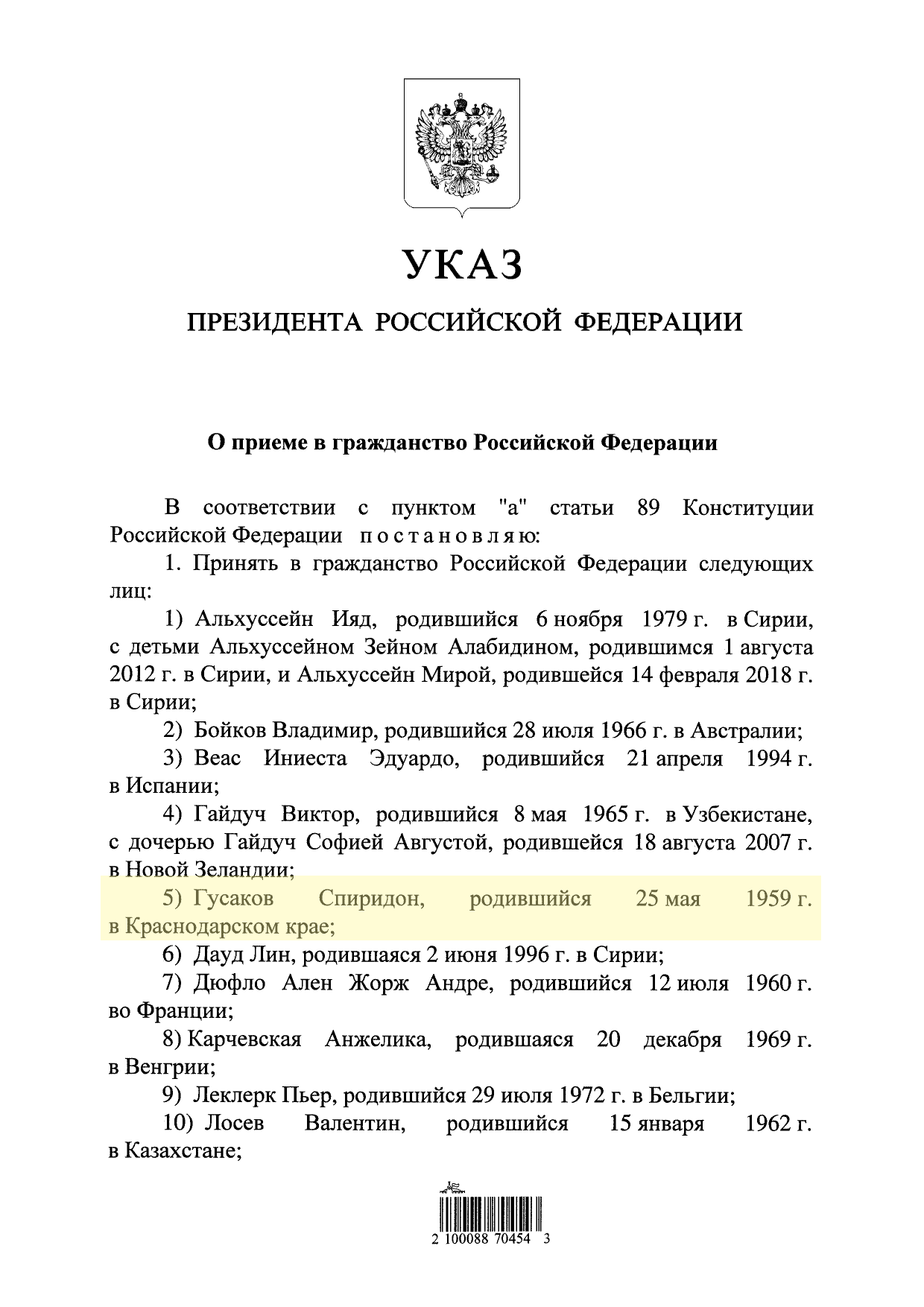
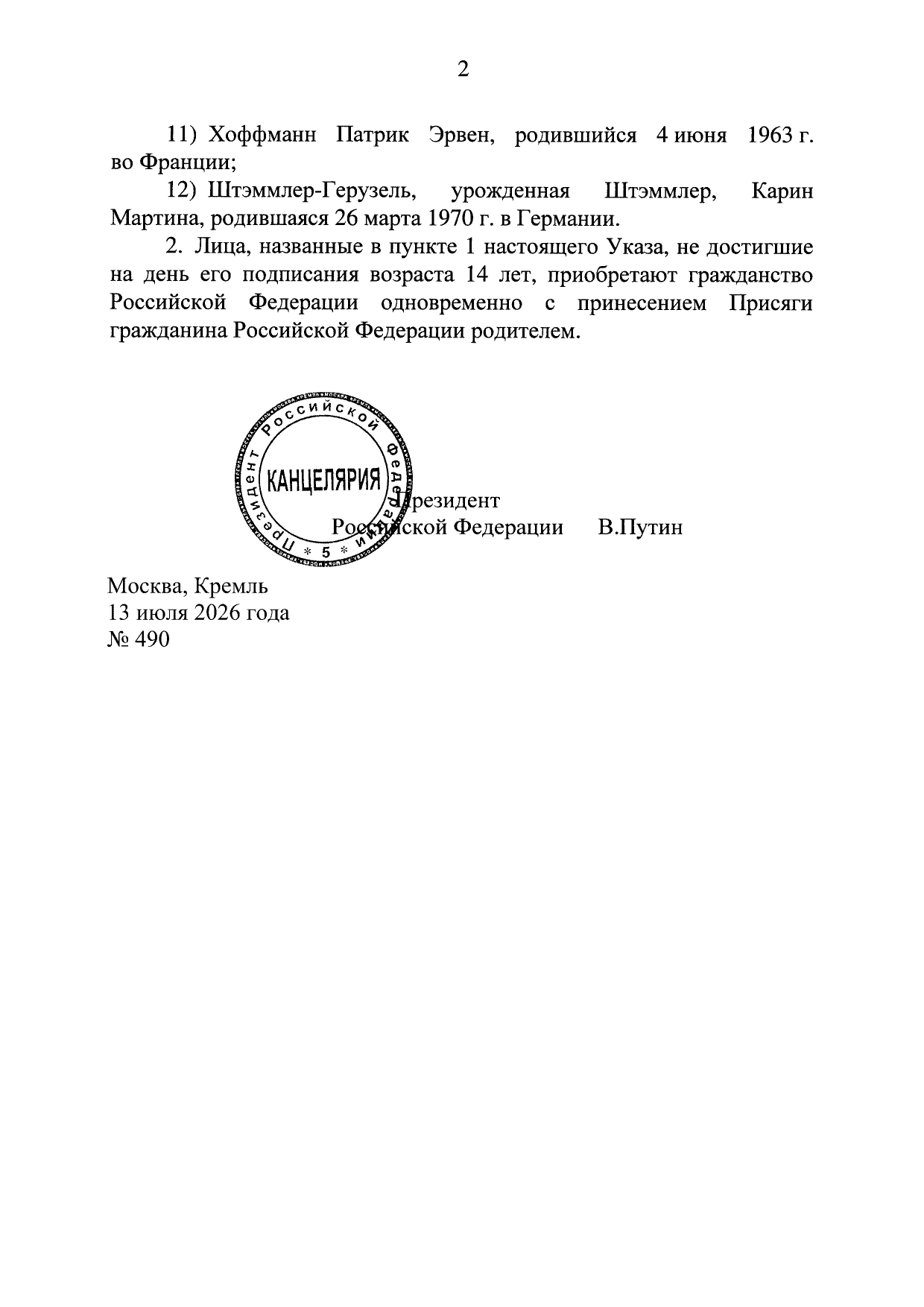
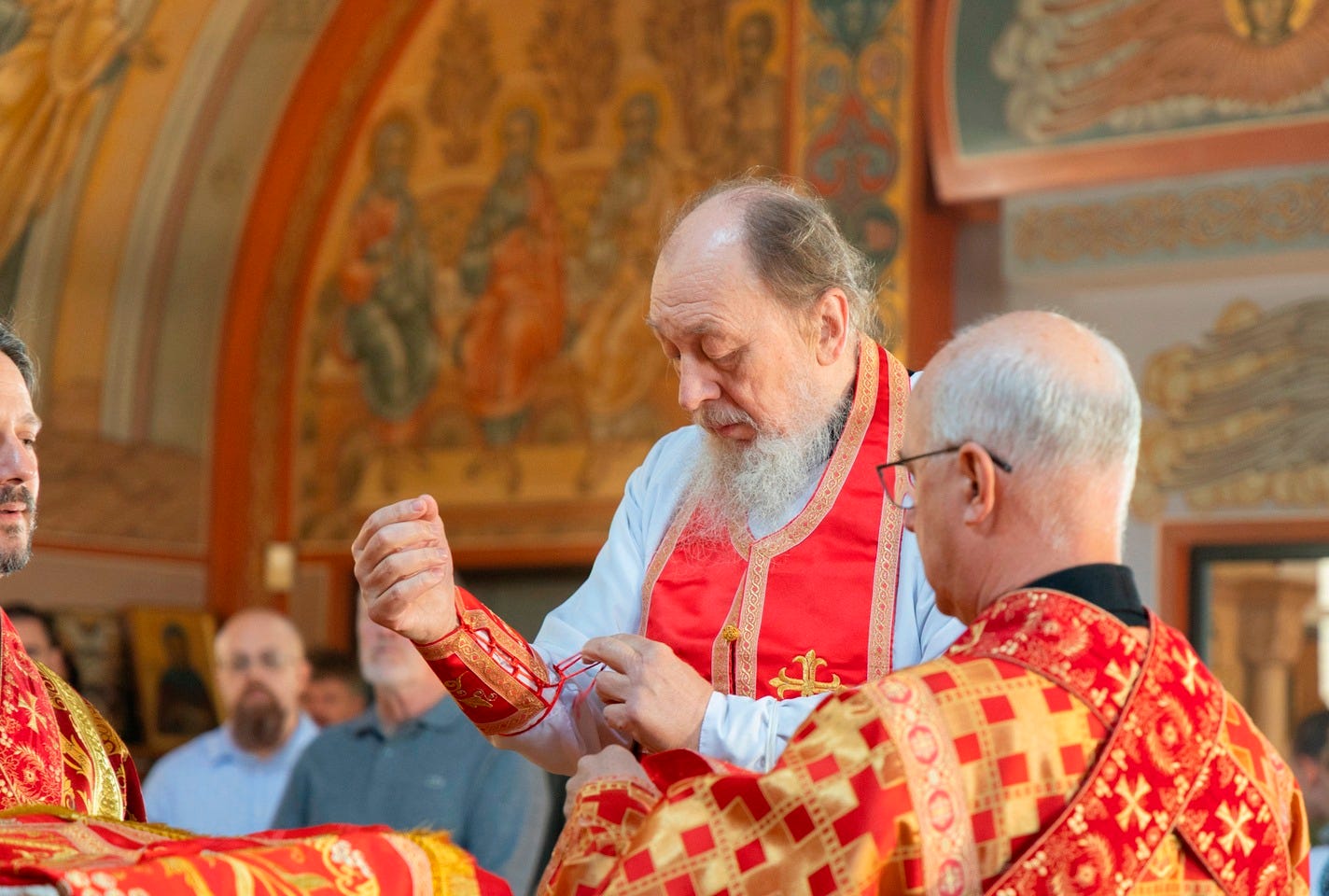
To date, however, ROCOR has not publicly explained the legal basis under which he presently performs those responsibilities. The question is not whether he occasionally visits the United States. It is whether an individual exercising continuing executive, religious, and financial authority within an American religious institution possesses the immigration status and employment authorization required under U.S. law to carry out those duties. Critics have also questioned why Spyridon’s Russian citizenship was publicly formalized while no comparable public clarification has been offered regarding his legal authority to serve in the United States.
One also wonders, as someone born in the USSR, what happened to his Soviet citizenship in the first place? His biography tells us he resided in Ukraine for 15 years from 1985, so did he assume Ukraininan citizenship after the USSR collapsed? And did he renounce it upon moving to Canada, or is he a dual citizen? And if so, why is Russian citizenship now being granted to him again, by the Russian President himself no less, and noted in a major Russian news outlet?
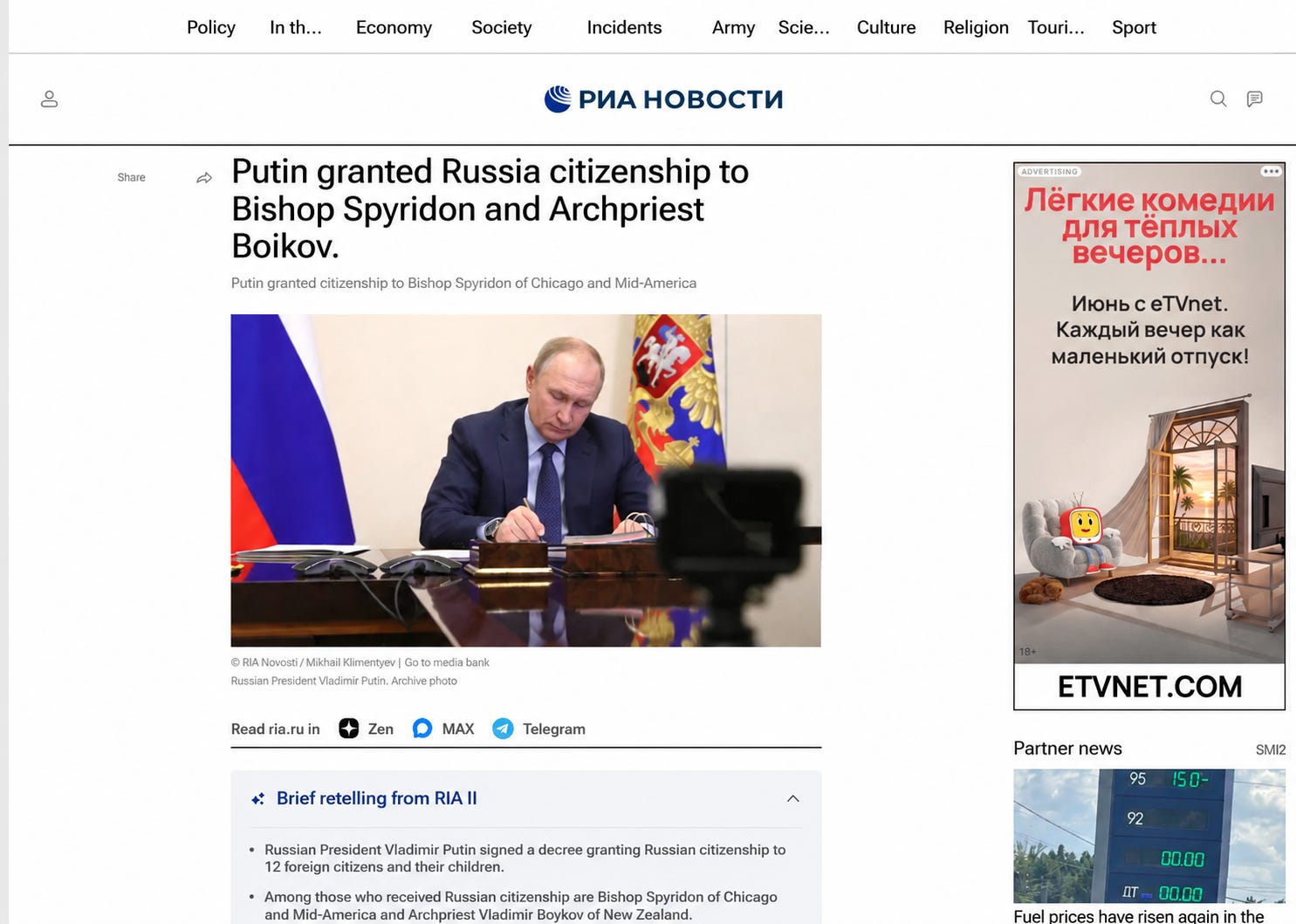
As with many other matters, ROCOR’s Metropolitan Nicholas, has not publicly addressed those questions. The citizenship status of a new bishop is of public interest and is central to regulatory and corporate governance responsibilities. The Metropolitan cannot keep the flock in the dark on such important matters and maintain a policy of silence like he has with the Matthew Williams abuse case.
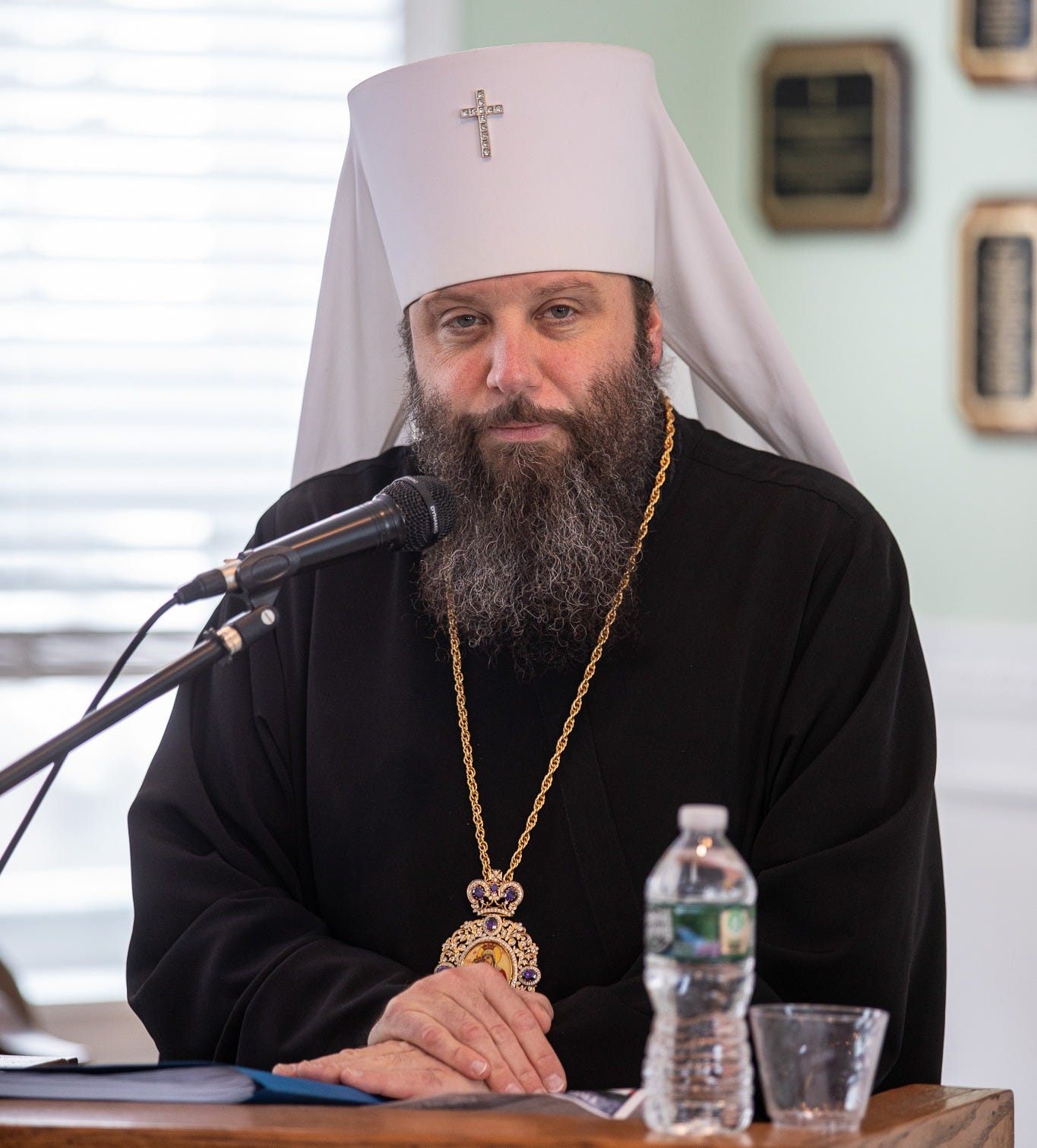
As a result, an issue that might otherwise have remained an internal ecclesiastical matter has increasingly attracted broader legal and public interest. For many observers, the central question is no longer simply why Bishop Spyridon was appointed. It is why this particular appointment appeared important enough to proceed despite questions that, to this day, remain unanswered.
Immediate Leadership Problems
If Archbishop Gabriel’s tenure had been defined by an effort to rebuild trust, many parishioners say the direction of the diocese changed almost immediately after Bishop Spyridon assumed office. One of his first major decisions was to halt the internal financial audit. Even more controversial, critics say, was what followed. Responsibility for determining the audit’s future was effectively transferred to individuals whose own conduct had been among the subjects of the investigation.
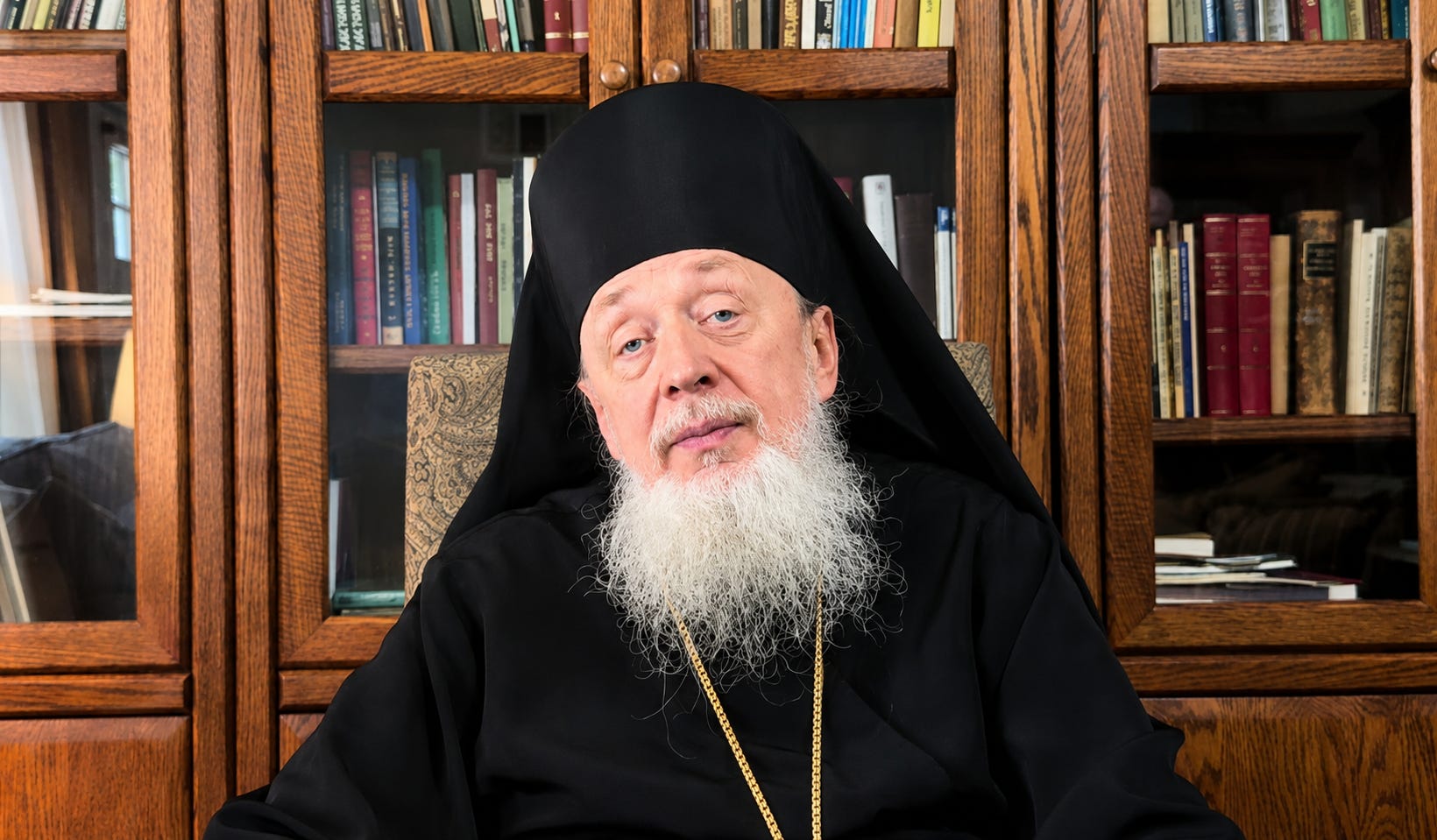
For many within the diocese, the implications were difficult to ignore. An inquiry intended to examine allegations of financial misconduct could no longer be regarded as independent if those potentially affected by its findings exercised influence over its outcome. Whether viewed as an institutional failure or simply poor governance, the result was the same: confidence in the integrity of the review largely disappeared.
Months later, many of the questions raised by the audit remain unanswered. Bishop Spyridon has not convened an open diocesan meeting to discuss the suspended investigation, the dismissal of school employees, allegations of intimidation, or the broader crisis of confidence that continues to affect the cathedral parish. Instead he has issued an address to parishioners of the Holy Virgin Protection Cathedral claiming that there were no missing funds, and attempted to write off serious financial irregularities as simple “mistakes”. This inability to give the serious weight due to such matters, raises questions about his appreciation of the importance of financial probity in registered religious organizations in the United States. America after all, is not a post-Soviet, Eastern European country. In the United States, proper corporate governance and financial accountability are serious legal and public confidence matters.
Many parishioners, disappointed by the direction events have taken, say they have even refrained from approaching the bishop for his episcopal blessing—a striking gesture within Orthodox church life. Others argue that the diocese has gradually returned to the same patterns that existed before Archbishop Gabriel’s arrival. According to many members of the congregation, key decisions are once again being shaped by the same circle of parish administrators who exercised considerable influence before Archbishop Gabriel attempted to reform the administration.
A Coverup Attempt ? “Trust Us - Everything is Fine”
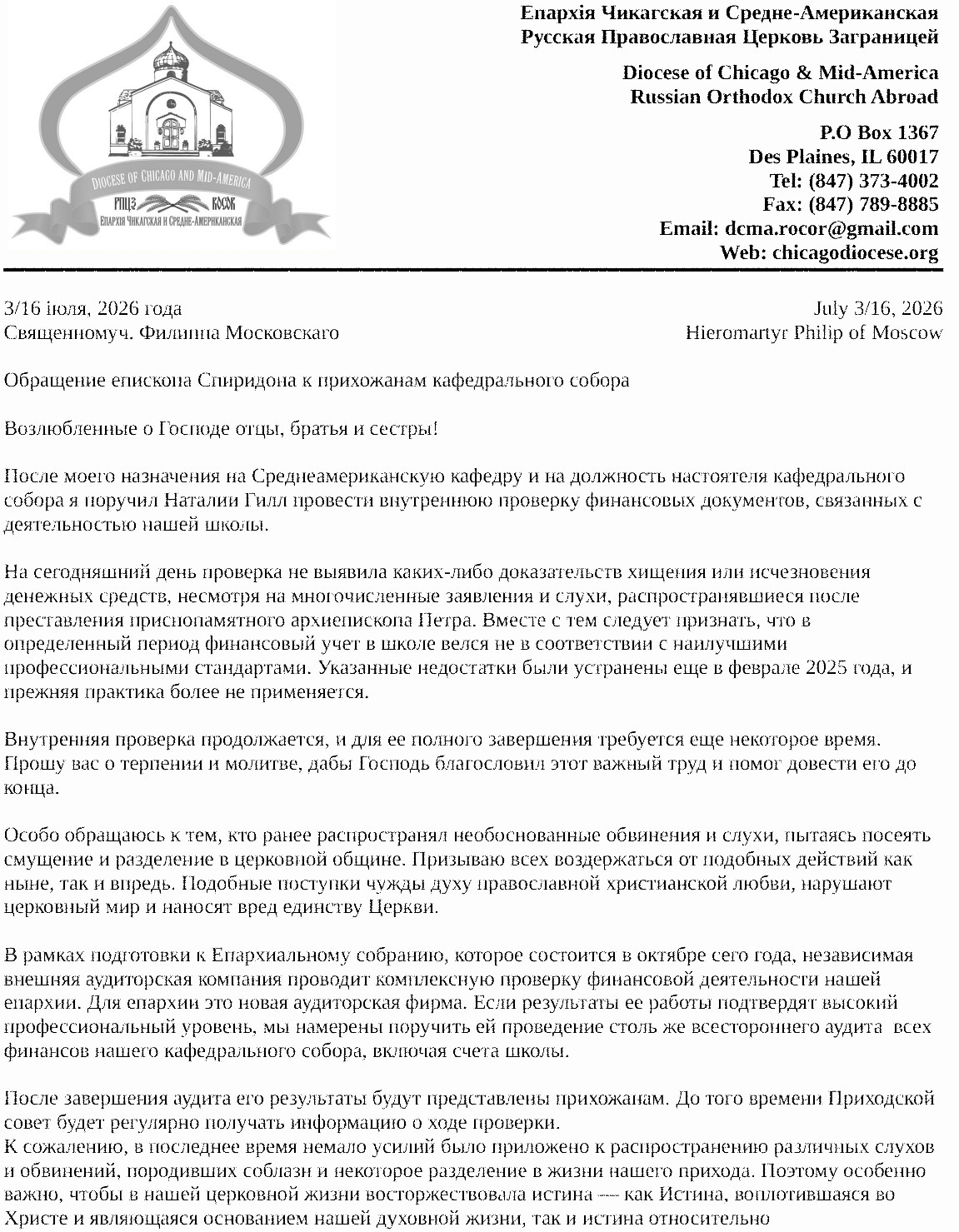
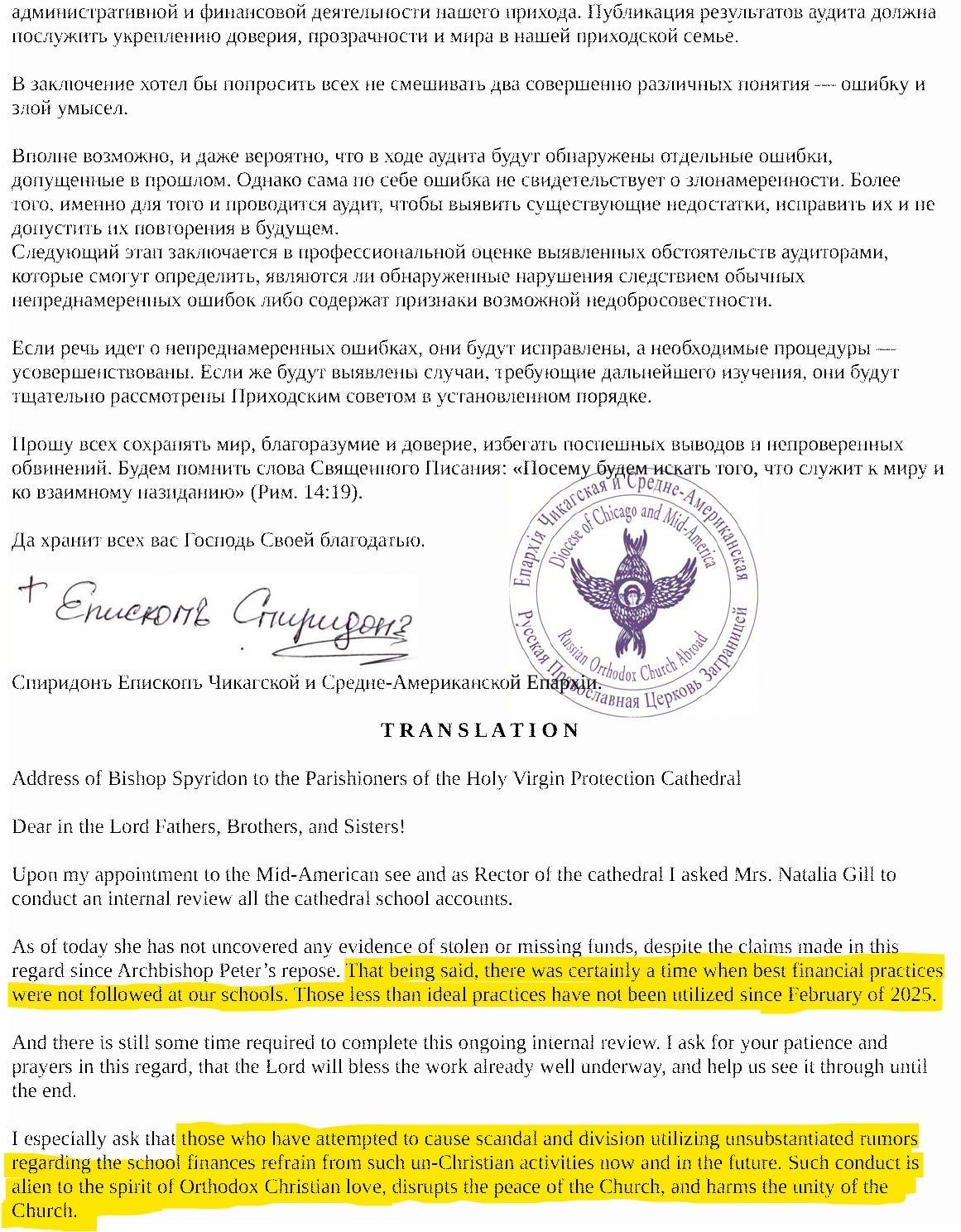
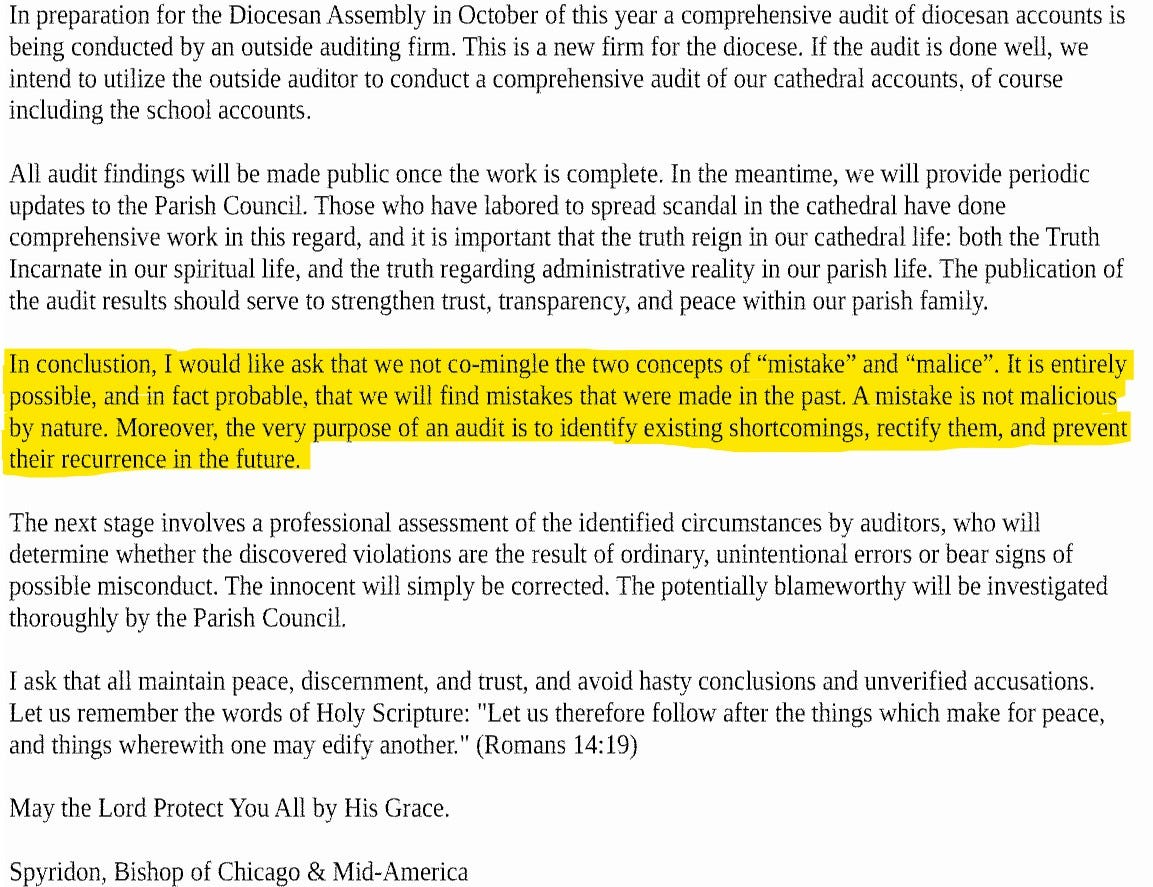
As often occurs in the cases of Church coverups, Bishop’s Spyridon’s address is highly manipulative of its intended audience. Disenting parishioners are immediately accused of:
"Causing scandal and division”
as well as being shamed for suppossedly being:
“Alien to the Spirit of Orthodox Christian love” & “disrupting the peace and unity of the Church”.
Regular Pokrov Truth readers will be familiar with these tactics of manipulation and gaslighting used by Church leaders when faced with uncomfortable situations. The message is always the same, if you question or dissent on anything in Church life, be it abuse or possible fraud, you are causing "scandal and division” and are “disrupting the peace of the Church”. Incidentally it was Metropolitan Nicholas himself who recently warned his pastors to not equate themselves to “the Church”. And yet here is one Nicholas’s latest appointments, enthusiastically using this very tactic against people that have questioned his decisions and only sought truth and accountability in parish life. And this has happened in just the first few months of his episcopal tennure.
The Choir That Was Expelled – Twice
No episode better illustrates the human cost of the conflict than the story of the cathedral’s children’s choir.
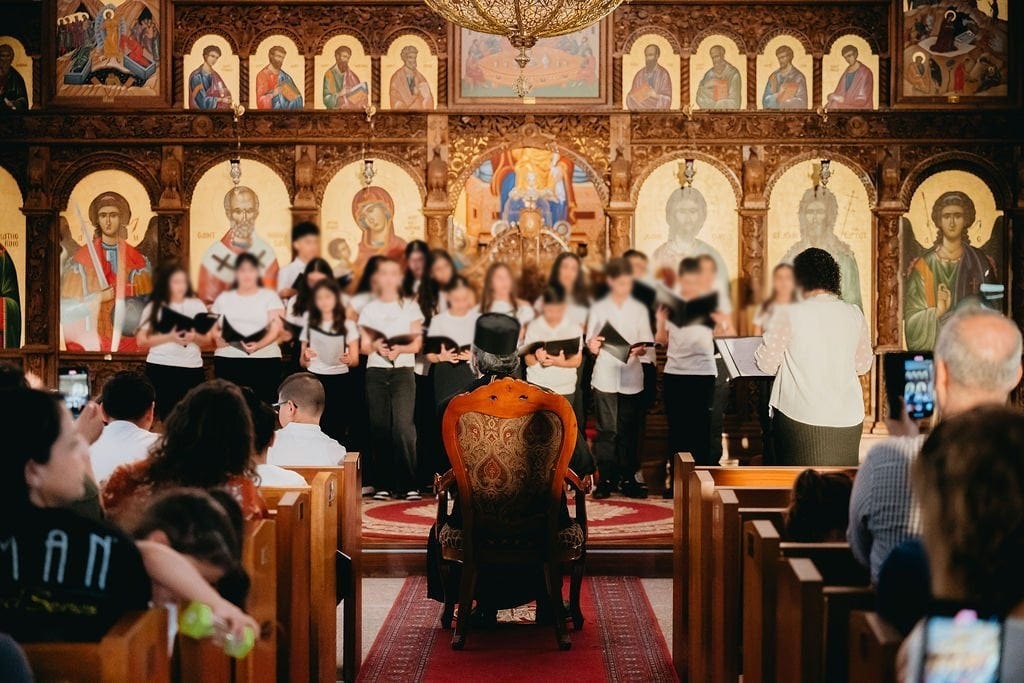
For years, it had been one of the parish’s defining ministries—a place where children grew up together, families became deeply involved in parish life, and generations of worshippers watched young voices become part of the cathedral’s identity. The conflict began during Archbishop Peter’s tenure. After the choir director appealed directly to Metropolitan Nicholas with concerns about conditions inside the parish, the response, according to numerous parishioners, was swift and devastating. The children were removed from the cathedral. This was not simply the suspension of a choir program.
The children themselves lost the place where they worshipped, served, and spent much of their religious lives. For many families, the decision felt less like an administrative measure than collective punishment imposed on children because of disputes among adults.
When Archbishop Gabriel arrived, one of his earliest acts was to reverse that decision. He restored the choir, welcomed the children back into the cathedral, and demonstrated that reconciliation—not retaliation—could guide the resolution of even the deepest conflicts. For many parishioners, it became one of the defining symbols of his leadership. That reconciliation did not last. Following Bishop Spyridon’s appointment, the children’s choir was once again removed. For the second time, the same children found themselves excluded from the cathedral community. To many parishioners, the symbolism was impossible to miss. What Archbishop Gabriel had painstakingly restored was dismantled almost as quickly as he had rebuilt it. The dispute was no longer merely about church music. It had become, in the eyes of many families, a reflection of how authority was once again being exercised within the diocese.
Fear Returns
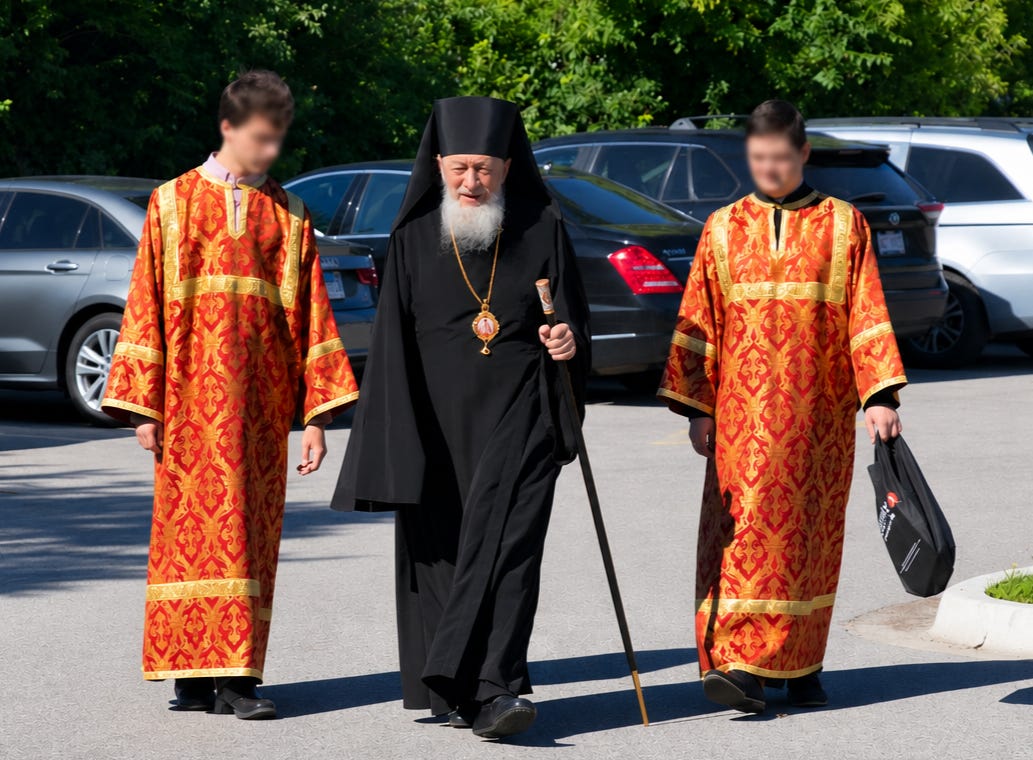
Many parishioners who welcomed Archbishop Gabriel’s efforts now say that the atmosphere which once defined parish life has begun to return. According to several members of the parish administration, “purges” were expected following the change in leadership. The concern extended beyond outspoken critics. Some parishioners feared that merely maintaining friendships with those viewed as opponents of the administration could itself become grounds for exclusion from parish life. Reports of dismissals, removal from volunteer ministries, public criticism, and social isolation began to circulate once again.
At the same time, parishioners describe the reemergence of organized smear campaigns targeting individuals holding contrary political opinions, or continued pressing for financial transparency within the parish.
Those allegations remain disputed, but critics argue that the broader objective of the campaigns was clear: not to resolve disagreements, but to delegitimize dissent. Whether every allegation can ultimately be substantiated remains a matter of debate. The broader effect, however, is difficult to overlook. An atmosphere of uncertainty returned. Parishioners increasingly describe weighing every conversation, every public statement, and every question carefully, concerned that disagreement with the administration could carry personal or professional consequences.
For many within the congregation, that sense of caution stands in sharp contrast to the brief period under Archbishop Gabriel, when they believed the diocese was moving toward greater openness, transparency, and mutual trust.
More Than a Church Dispute: The Questions Remain
The conflict within ROCOR’s Diocese of Chicago and Mid-America can no longer be understood simply as an internal disagreement between clergy, parishioners, and church administrators. It raises broader questions about corporate governance, institutional accountability, transparency, and the responsibilities of religious leadership.
Why was an independent financial review halted before its work was completed?
Why was its future effectively placed under the influence of those whose conduct had been under examination?
Why did an appeal signed by over 150 parishioners fail to alter the outcome?
Why did the bishop whom Archbishop Gabriel had spent years mentoring as his eventual successor in Canada instead assume leadership of the Chicago Diocese at the very moment Gabriel’s efforts toward financial transparency had reached their most sensitive stage?
Why were children forced to experience expulsion from their cathedral twice—first under Archbishop Peter, and then again after Bishop Spyridon assumed office?
Why has ROCOR’s leadership never publicly explained the legal basis on which Bishop Spyridon, a Canadian citizen who also received Russian citizenship by decree of President Vladimir Putin, carries out continuing administrative and financial responsibilities within the United States?
And why, according to so many parishioners interviewed for this account, have those seeking answers so often described encountering intimidation, exclusion, dismissals, and public smear campaigns rather than open discussion?
None of these questions, by themselves, provide definitive conclusions. Taken together, however, they describe a pattern that many clergy and parishioners believe deserves far greater scrutiny than it has received. The story of Bishop Spyridon is therefore about far more than the rise of a single church leader.
It is also the story of a diocese that briefly appeared to move toward reconciliation before once again becoming consumed by mistrust. For many Orthodox Christians in Chicago, Archbishop Gabriel represented something larger than an administrator. He represented the possibility that honesty could prevail over institutional self-protection, that transparency could strengthen rather than weaken the Church, and that pastoral leadership could unite a divided community instead of deepening its fractures. Whether that opportunity was ultimately lost—and why—remains one of the defining questions facing the Diocese of Chicago and Mid-America today.
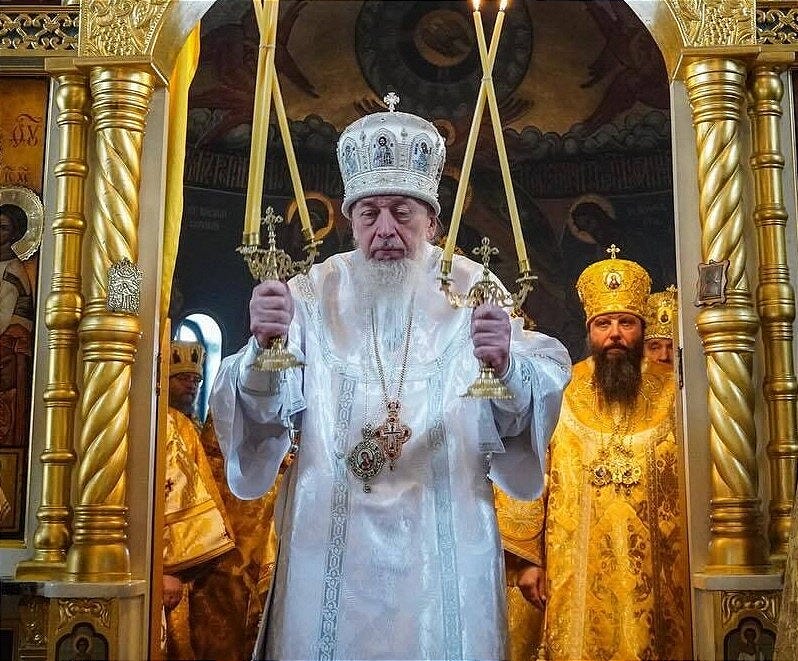
The Future for the Diocese of Chicago & Mid-America
This account does not claim to answer every question surrounding the events that reshaped one of ROCOR’s most prominent dioceses. Many of the issues discussed here remain contested.
Others may ultimately require independent legal, financial, or ecclesiastical review before definitive conclusions can be reached. What is beyond dispute, however, is that the controversy has left deep divisions within the community and profound questions that have yet to receive clear public answers. Until those questions are addressed openly by Metropolitan Nicholas, the appointment of Bishop Spyridon is likely to remain remembered not simply as a routine episcopal transition, but as the moment when a diocese that seemed on the verge of reconciliation found itself drawn back into conflict. Whether history ultimately judges that turning point as necessary, avoidable, or deeply misguided will depend less on competing narratives than on the willingness of Church leaders to embrace the transparency, accountability, and openness that so many parishioners continue to seek.
Promoting Spyridon was clearly a rebuke of Gabriel by the jealous and incompetent Nicholas. Gabriel is well-liked and has a good reputation. If the flock were to see too long a period of improvement, they might start to question why this does not exist elsewhere.
Guys, you’re doing a great job!! Keep digging!! We’ve got a similar situation at our parish in Michigan. Our rector is going after the audit too. He even tried to brazenly take over the neighboring parish, using the power he has in the diocese and his influence with the Metropolitan. And yet he looks so innocent — this tiny little guy, batting those baby-blue eyes…